Above Brisbane’s streets, a point-to-point wireless link can connect two buildings without following the underground cable route between them. For the right locations, that creates another way to deliver substantial capacity across the city.
Capti’s Brisbane CBD-to-CBD Siklu E-band installation provides a 10Gbps full-duplex link. The project brings together rooftop access, radio-path engineering, installation and network integration to connect two city locations.
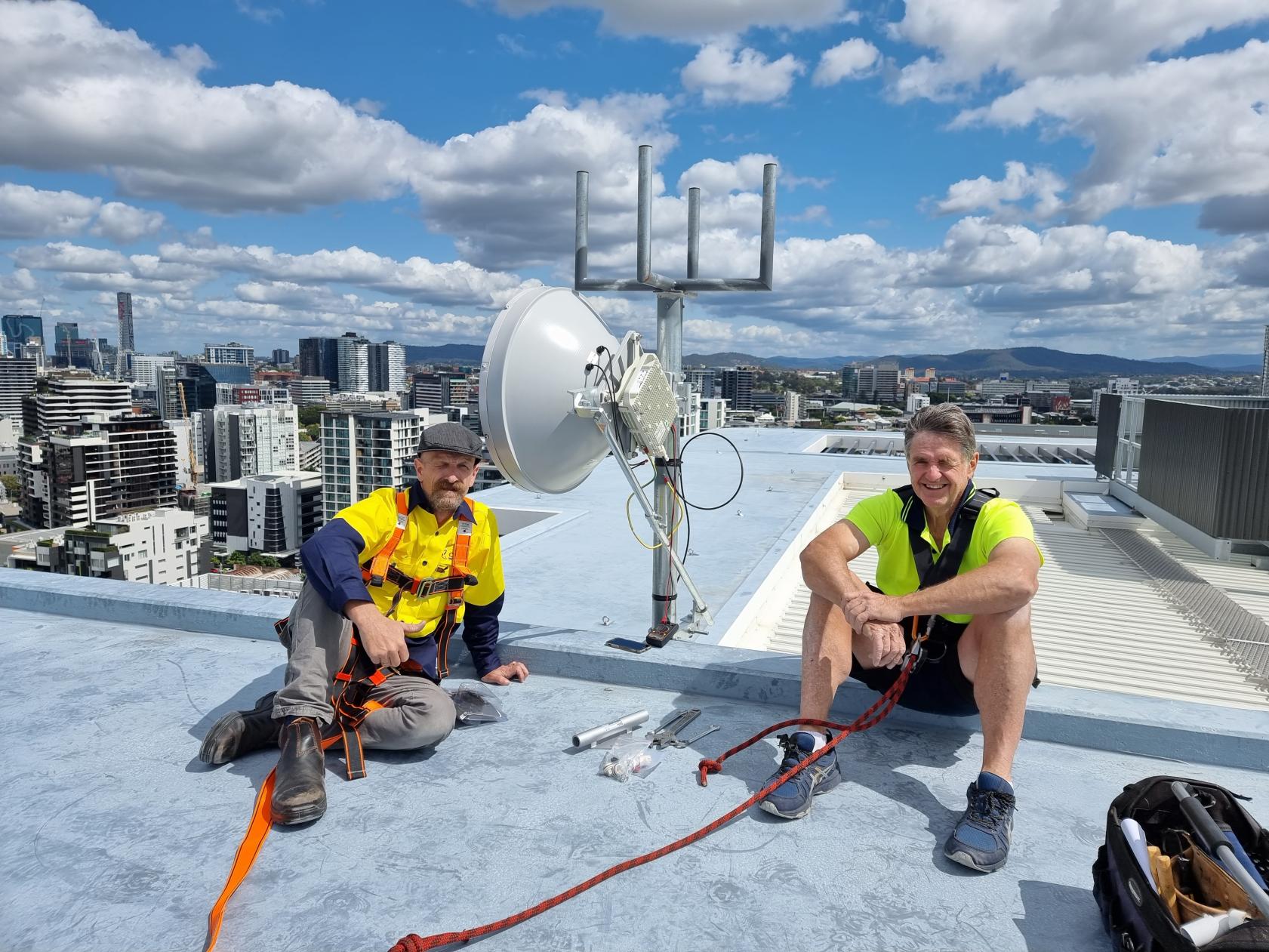
The installation photograph shows the team and rooftop equipment from the project. The technology is important, but the service depends on the design around it: the path, mounting, power, handovers and ongoing operation.
What 10Gbps full duplex means
Full duplex means the link can transmit and receive simultaneously. For this installation, the stated capacity is 10Gbps in each direction, rather than a single 10Gbps pool shared between sending and receiving.
That describes the radio-link capacity. Application throughput depends on Ethernet overheads, the connected equipment and the service configuration. It does not mean every user receives a 10Gbps internet plan or achieves that speed on Wi-Fi.
When specifying a connection, distinguish the radio capacity, the Ethernet handover and the internet or private-network service being delivered. Those details establish what a business can actually use.
How Siklu E-band connects buildings
E-band uses millimetre-wave spectrum in the 70/80GHz range. Directional antennas establish a point-to-point connection between suitable sites, with equipment at each end connecting the radio path to the wired network.
The Siklu by Ceragon EtherHaul family includes 10Gbps E-band equipment. Model, capacity licence and configuration determine the capabilities of a particular installation.
For a CBD project, the assessment includes a clear radio path, rooftop permissions, mounting locations, cable routes, power and building handovers. A visible neighbouring rooftop is a starting point for investigation, not a complete design.
Low latency: look beyond the speed headline
Capacity describes how much data a connection can carry. Latency describes how long data takes to travel. Both matter to businesses using interactive applications, remote desktops, voice, video and services hosted elsewhere.
A direct E-band path can support low-latency connectivity between buildings. The end-to-end result also includes radio processing, switches, routers, traffic queues and the route to the destination. A fast radio hop cannot remove delays elsewhere in that journey.
When comparing proposals, ask whether a latency figure describes one-way delay or round-trip time, where the measurement starts and ends, and whether it was measured under load. Jitter—the variation in delay—and packet loss also affect the experience.
This article confirms the project’s 10Gbps full-duplex capacity. It does not quote a measured latency result or promise a particular internet ping for this installation.
Engineer for Brisbane weather and the actual path
E-band performance needs a site-specific design. Distance, rainfall, antenna size, alignment and mounting stability all influence the link budget: the calculation used to assess whether sufficient signal reaches the other end.
The design should identify the required capacity and availability, including what happens in adverse conditions. Where adaptive modulation is used, maintaining a connection at reduced capacity is different from maintaining the full 10Gbps rate.
Avoid treating a maximum equipment specification as an all-weather service commitment. The proposal should explain the capacity expected for the path, the resilience arrangement and the basis of any availability target.
Directly connected to Capti’s Cisco MPLS network
The Brisbane CBD-to-CBD link connects directly into Capti’s Cisco MPLS network. MPLS is a technology used to carry and organise traffic across a provider’s core network; it allows the rooftop connection to form part of a wider managed network service.
That gives the project a network beyond the radio hop. Internet access, private site-to-site services and onward connectivity can be scoped around the customer’s requirements, with destinations, capacity and support responsibilities defined in the proposal.
A connection into the MPLS core does not by itself guarantee an application’s latency or provide encryption. Those requirements should be specified as part of the end-to-end service design.
Where a high-capacity wireless link fits
A CBD-to-CBD connection can support a private link between offices, extend a network to another building or carry traffic towards a wider business network. These are applications to assess against each site’s requirements, rather than additional claims about this specific project.
For a connection towards a data centre or cloud service, define the complete route and the services required beyond the rooftop link. Wireless access is one component; destination connectivity, cross-connects and provider arrangements need their own scope.
Our commercial building fibre and connectivity guide explains how tenant services, building systems and external connections fit into a wider property plan.
Faster delivery where trenching can be avoided
A suitable rooftop wireless path can avoid the excavation and underground cable construction that a new fibre route may require. Where sites and access are ready, this can offer a faster installation route for a business that needs capacity sooner.
Delivery still depends on the path assessment, rooftop permissions, mounting works, equipment availability, applicable radio authorisations, power and internal cabling. Capti confirms the installation programme for the actual site rather than promising a universal turnaround.
Disaster recovery and protection from road cuts
The over-the-air span has no cable in the road between its two rooftops. Excavation damage along that street cannot sever the wireless span in the way it can cut an underground fibre cable.
This makes fixed wireless worth assessing as an alternative path alongside fibre for disaster recovery and business continuity. It is not immunity from every outage: building cabling, power, rooftop equipment and onward network connections can still be affected.
The recovery plan should identify the services that must remain available, the capacity needed on the alternative connection, how failover occurs and how it is tested. Backup service capacity and independence need to be confirmed for each design.
Complement fibre with a genuinely different path
Fixed wireless may provide an alternative where a new cable route is difficult. It can also form part of a resilience design alongside fibre, subject to assessment of the paths and their shared dependencies.
Two connections are not automatically diverse. They may still depend on the same power supply, building equipment or upstream network. A useful design identifies those dependencies and defines failover behaviour.
Read our guide to diverse fibre and fixed wireless connections for the questions to ask when planning a second path.
From rooftop installation to a managed service
The finished installation needs more than aligned antennas. Confirm the handover interfaces, capacity settings, monitoring, management access and the support responsibilities on each side of the link.
Commissioning should test the agreed service, including throughput in both directions, packet loss and latency between defined endpoints. Where backup arrangements are included, test their operation and document any capacity changes during failover.
Keep the handover records with the circuit details and support contacts. That provides an operational baseline for future troubleshooting and upgrades.
Assess a high-capacity link for your building
Capti can assess fixed wireless connectivity between suitable Brisbane locations, including high-capacity requirements where a standard connection does not fit the project.
Share the two building addresses, required capacity, rooftop access arrangements and resilience needs. We can then assess the path and propose the equipment, installation and management scope.
Talk to Capti about a high-capacity fixed wireless connection, or explore our point-to-point wireless services.