Buying two internet services feels like a sensible continuity plan. But if both cables enter through the same pit, terminate on one router and depend on the same power board, the business may still have a single point of failure.
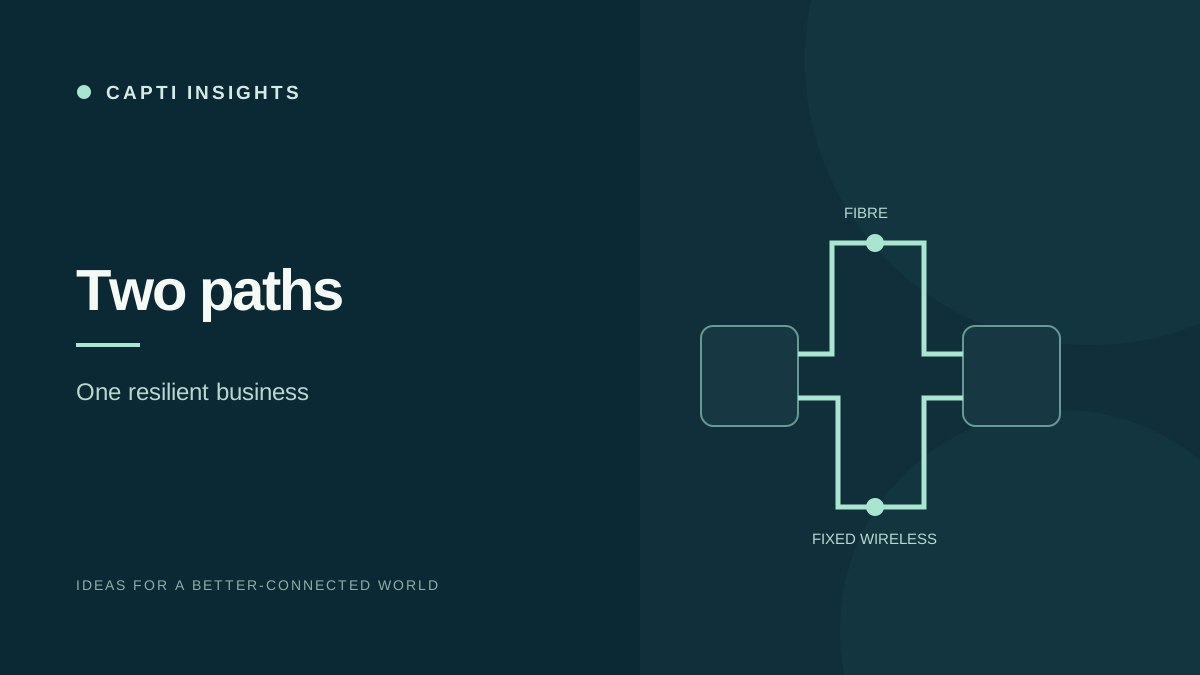
Fibre plus fixed wireless can create strong diversity because the access methods are physically different. That difference is valuable—but it is not a guarantee. Genuine resilience comes from understanding the complete path of each service and testing how the business behaves when one disappears.
Capti offers business fibre and fixed wireless, giving our team a starting point for discussing physically different access paths.1 The right design, however, remains site-specific: network availability, building layout, line of sight, applications and recovery objectives all matter.
Redundancy and diversity are not the same
Redundancy means there is another component or service available. Diversity means the alternative avoids relevant failure points in the primary path.
Two fibre services can be diverse if their routes and dependencies are genuinely separate. Fibre and fixed wireless can still share risks if they use the same rooftop power, building riser, provider core or customer firewall. Technology labels tell you the medium; they do not describe the whole failure domain.
A useful design question is not “Do we have two links?” It is: “Which incidents should we survive, and what does each incident affect?”
Examples include a cable cut in the street, loss of building power, failure of customer equipment, a carrier outage, rooftop access damage, a configuration error or an upstream cyber event. No practical design eliminates every risk. The goal is to match controls to the operational consequence.
The four layers of diversity
1. Physical diversity
Physical diversity separates tangible assets. A fibre service normally reaches the premises through ducts, pits and building pathways. A fixed-wireless service reaches an antenna by radio, which may bypass a damaged street conduit.
Look beyond the final access medium. Trace where each service enters the building, where cables run internally, where equipment is mounted and where both paths first converge. If the radio’s indoor cable and the fibre patch share a vulnerable riser or cabinet, that point should be documented.
For high-consequence sites, request route information at an appropriate level and validate what can realistically be confirmed. Exact carrier routes can change or may not be fully disclosed, so phrase procurement requirements around demonstrated separation and agreed notification processes rather than impossible certainty.
2. Path diversity
Path diversity asks whether traffic takes separate routes beyond the property. A rooftop radio that lands at a nearby network site may avoid the fibre’s local exchange route. But the services could converge shortly afterwards onto the same aggregation device, backhaul or point of presence.
A simple path diagram is often more useful than pages of product descriptions. Draw the customer edge, building entry, access network, aggregation, provider core, internet interconnects and critical cloud destinations. Mark known shared components and unknowns.
3. Carrier diversity
Using two providers can reduce exposure to one provider’s operational or core-network event. Yet different retail brands may use the same wholesale access, ducts, upstream transit or field contractors. Conversely, one provider may be able to engineer diverse services across separately operated access networks.
Do not treat “two invoices” as proof. Ask who owns and operates the access for each service, which support desk controls restoration, whether planned maintenance could affect both, and how incidents involving an underlying wholesaler are escalated.
4. Power and equipment diversity
Most dual-link designs still depend on local power and common customer equipment. Map the power chain for the fibre network termination, radio equipment, routers, firewalls, switches and Wi-Fi access points.
Consider appropriately designed UPS coverage, separate power circuits where justified, and generator integration if the building has it. Battery runtime should align with the likely outage scenario and the business process you need to preserve. A wireless link may remain available from the provider while the customer’s rooftop injector has lost power.
The customer edge is another decision point. One dual-WAN firewall is simple, but it is one device. A pair of edge devices can reduce that risk while adding cost and configuration complexity. Choose deliberately, then back up and control the configuration.
Design failover around applications
Failover is not merely moving packets. Sessions may reset, public IP addresses may change, virtual private networks may need to re-establish, and inbound services may become unreachable. Cloud security controls can also treat traffic from the backup path differently.
Classify applications before selecting a mechanism:
| Application type | Questions to answer |
|---|---|
| Cloud productivity and web | Will new sessions reconnect automatically? |
| Voice and video | How much interruption is tolerable? Will active calls drop? |
| Site-to-site VPN | Does the backup have compatible addressing and configuration? |
| Inbound hosting | How will DNS, routing or traffic steering change? |
| Payment and operational systems | Are backup-path addresses allowlisted? |
| Large transfers and backup | Should these pause to preserve capacity for critical traffic? |
The backup does not always need to match the primary link’s capacity. It does need enough usable capacity for the prioritised workload. Apply traffic policies so software updates or off-site backups cannot crowd out calls, transactions and remote access during an incident.
Test what happens on a bad day
An untested backup is an assumption. Run controlled exercises during an approved window:
- Record normal routes, latency and application behaviour.
- Disconnect or administratively disable the primary path.
- Measure detection and failover time.
- Test critical outbound, inbound, voice and VPN workflows.
- Confirm monitoring alerts reach the right people.
- Restore the primary and observe failback behaviour.
- Record issues, owners and retest dates.
Repeat tests after firewall changes, carrier migrations and major application releases. Also test failures beyond the access link when feasible; disabling a port proves a narrow scenario, not every outage.
Questions to take to providers
- Is the wireless service delivered over infrastructure separate from the fibre access path?
- Where do the two services enter the premises and first converge?
- Which ducts, risers, power supplies, devices and upstream networks are shared?
- Who operates each access network and handles restoration?
- What equipment sits at our site, and who monitors it?
- What addressing and routing options support our applications?
- How will planned maintenance and incidents be communicated?
- Which details can be documented in the solution design?
Resilience should be visible
The strongest design is one your team can explain in a diagram, operate under pressure and verify with tests. Fibre plus fixed wireless can remove important common risks, especially around the last physical access path, but only when the surrounding architecture supports that goal.
Capti can assess business fibre and fixed-wireless availability and discuss how the access paths fit your site.1 Bring your critical application list, outage objectives and building constraints to the conversation. That produces a more useful design than simply ordering “a backup link”.
For more detail, read about the Tangalooma resort microwave project. Explore fixed wireless connectivity for your location.