As an Internet Service Provider (ISP) specialising in MPLS, we understand the nuances and key considerations that businesses must weigh when choosing between these solutions. This article explores the pros and cons of MPLS and SD-WAN, aiming to guide you toward the best choice for your business needs.
Understanding MPLS: The Established Backbone
MPLS has long been the gold standard for enterprise networks, offering a private network designed to provide secure, reliable, and high-performance connectivity for businesses. MPLS is not just a technology; it's a comprehensive solution designed to deliver superior network performance, security, and reliability. Its architecture allows for the prioritisation of critical business applications, ensuring that real-time services such as VoIP, video conferencing, and mission-critical data applications run smoothly and without interruption.
Pros of MPLS:
- Enhanced Network Performance and Reliability: MPLS stands out for its ability to provide consistent, high-quality performance. By steering data across predefined paths, it minimises latency and packet loss, ensuring dependable connectivity for all enterprise applications.
- Advanced Quality of Service (QoS): MPLS networks excel in managing bandwidth allocation, prioritising network traffic to guarantee that high-priority applications receive the bandwidth they need to operate effectively. This level of control is crucial for businesses that depend on real-time data transmission.
- Enhanced Security: Operating on a private network, MPLS inherently offers a higher level of security than public internet-based solutions, with data traffic kept away from the potentially vulnerable public internet.
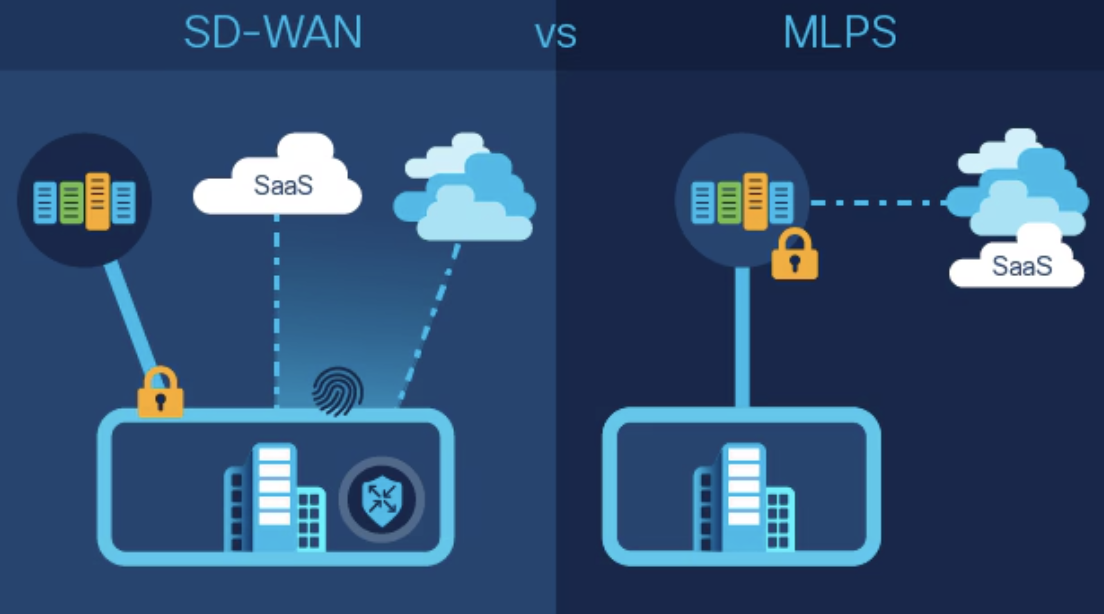
- Centralised Security and Control: One of MPLS's key advantages is the centralised control it offers over network traffic, creating a single, secure choke point through which all traffic can be efficiently managed and monitored. This contrasts with SD-WAN architectures, which often require managing security policies and controls across multiple internet routers and points of presence. The centralised model of MPLS simplifies network security management, enabling more stringent and unified security policies that are easier to enforce across the entire network.
- Cost Efficiency Through Simplified Infrastructure: A notable advantage of MPLS is the reduction of reliance on expensive, proprietary hardware. With the intelligence and routing complexities managed by the ISP's network, businesses can avoid the high costs associated with purchasing and maintaining specialised SD-WAN appliances. This not only results in direct cost savings but also simplifies network management and operations.
Cons of MPLS:
- Scalability and Flexibility Challenges: Expanding or modifying an MPLS network can be a complex and time-consuming process, requiring physical changes and additional hardware.
Understanding SD-WAN
SD-WAN has emerged as a powerful alternative to MPLS, designed to meet the demands of modern, cloud-centric business environments.
Pros of SD-WAN:
- Rapid Scalability: SD-WAN offers unparalleled flexibility, allowing businesses to quickly add new sites or adjust network configurations through software controls without the need for physical infrastructure changes.
- Integrated Security Features: Many SD-WAN solutions include built-in security measures, such as encryption and firewalls, providing comprehensive protection for data traffic.
- Optimised for the Cloud: SD-WAN inherently supports cloud services and applications, offering improved performance and user experiences for cloud-based workflows.
Cons of SD-WAN:
- Dependence on Public Internet: SD-WAN's reliance on public internet connections introduces variability and security concerns. This dependence can lead to fluctuating network performance and potential reliability issues, as public internet infrastructure is prone to congestion and inconsistent speeds. These factors can significantly impact applications requiring stable and predictable performance.
- Vendor Lock-In and Hardware Dependencies: SD-WAN solutions often necessitate proprietary hardware and software, leading to potential vendor lock-in. This limitation can restrict future network expansion and technology adaptability, posing risks and additional costs if business needs change or if there's a desire to integrate new technologies.
- Increased Latency and Unpredictable Paths: Unlike MPLS, which offers consistent and predictable network paths, SD-WAN routes traffic over the public internet, where the path of data packets is less predictable. This can result in increased latency, particularly for real-time applications like VoIP and video conferencing, where even minimal delays can degrade user experience.
- Complexity in Managing Multiple ISPs: To achieve redundancy and optimal performance, SD-WAN networks often utilise multiple internet service providers (ISPs). However, this approach introduces complexity in managing relationships, contracts, and technical configurations across different ISPs, adding an administrative burden and potential challenges in troubleshooting and performance optimisation.
- Security Challenges Over Public Connections: While SD-WAN technologies include integrated security features, the inherent risks of transmitting data over public internet connections require additional security measures. Businesses must invest in and manage comprehensive security solutions, such as encryption and advanced threat protection, to safeguard their data against interception and cyber threats.
Making the Right Choice for Your Business
When determining whether MPLS or SD-WAN is the best fit for your organisation, consider the following factors:
- Application Requirements: If your business relies heavily on real-time applications, the predictable performance of MPLS may be more suitable. However, for cloud-focused operations, SD-WAN's optimisation capabilities offer clear advantages.
- Budget Constraints: Evaluate the cost implications of each solution. SD-WAN may provide cost savings, especially for businesses looking to reduce upfront capital expenditures and operational costs.
- Security Needs: While both solutions offer security features, the inherent privacy of MPLS might be preferable for businesses with stringent security requirements.
- Scalability and Flexibility: Consider your business's growth trajectory and the need for network adaptability. SD-WAN's ease of scaling and flexibility can support rapid expansion and dynamic changes.
In navigating the complex landscape of network solutions, the decision between MPLS and SD-WAN hinges on a thorough understanding of your business's unique requirements, priorities, and aspirations. At Capti, we're committed to guiding you through this critical decision-making process. Our expertise and comprehensive range of network solutions ensure that you're equipped with the information and technology needed to propel your business forward. With a focus on personalised service, we'll help you evaluate your options and implement a network strategy that aligns with your goals for growth, security, and operational efficiency. Partner with Capti, and let us empower your business with the connectivity it deserves to thrive in the digital era.
For more detail, read about designing diverse fibre and wireless connections. Explore business fibre options for your location.