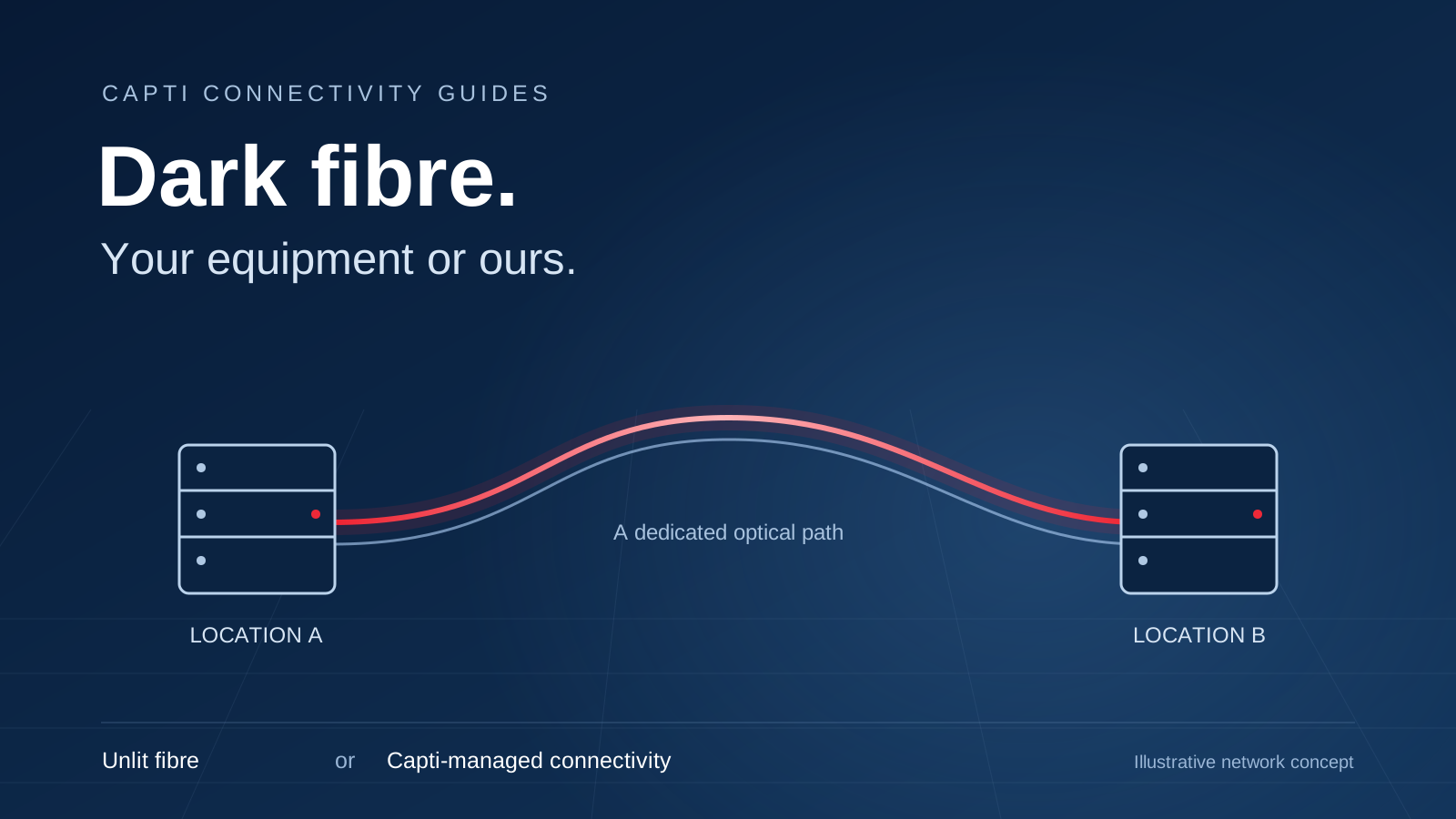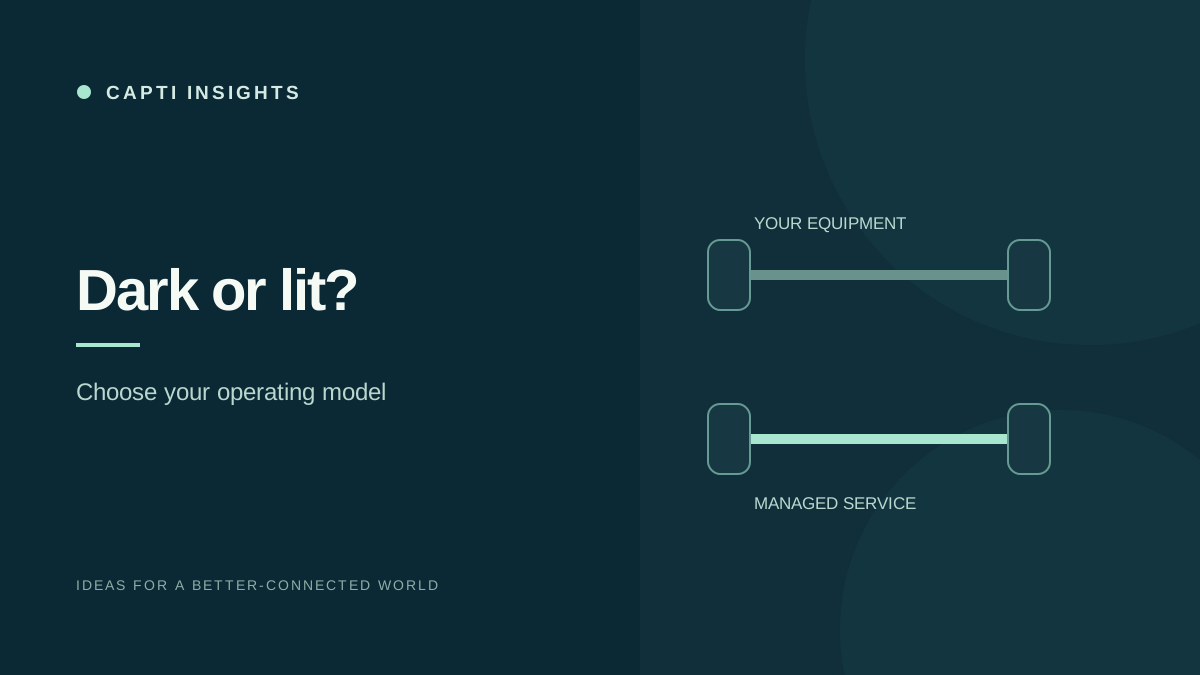
“Dark fibre” sounds powerful—and it can be. But it is not simply a faster version of business internet. It is customer-controlled, unlit optical fibre that must be equipped, operated and connected to useful destinations. Managed business fibre is a lit communications service: the provider operates the transmission layer and delivers an agreed service at the customer hand-off.
That distinction changes the investment case. One option gives the organisation more control and responsibility; the other buys an operating outcome. A CFO-friendly comparison should therefore examine total cost, internal capability and risk—not just monthly charges or theoretical capacity.
Capti offers both Dark Fibre and Business Fibre services.1 Availability and commercial terms are location- and design-dependent, so use the framework below to prepare a proper options assessment rather than assume either model is universally better.
First, define what is being bought
With dark fibre, the supplier provides an optical path between defined endpoints, but does not “light” it to create the transmission service. The customer—or a specialist working for the customer—supplies optical transceivers and active equipment, selects the transmission design, monitors performance and manages capacity. Internet access, cloud connectivity or data-centre cross-connects are separate pieces unless explicitly included elsewhere.
With managed business fibre, the provider lights and operates the network and presents a service, commonly through an Ethernet interface. The provider takes responsibility for its network equipment and service operation within the contract’s boundaries. The customer still needs suitable routers, firewalls, LAN capacity and internal support.
The decision table
| Consideration | Dark fibre | Managed business fibre |
|---|---|---|
| What you receive | Customer-controlled unlit optical path | Provider-operated lit service |
| Active optical equipment | Customer responsibility | Generally provider responsibility within the service boundary |
| Capacity changes | Controlled by customer equipment and fibre design | Ordered within available provider service options |
| Operational skills | Optical design, monitoring, spares and fault isolation required | Provider operates its network; customer manages its edge and applications |
| Fault ownership | Can span fibre, customer optics and third parties | One provider owns more of the service diagnosis within scope |
| Initial investment | Can include optics, chassis, installation and spares | Usually lower customer investment in transmission equipment |
| Ongoing cost | Fibre rights plus equipment lifecycle and operations | Contracted service charges plus customer-edge costs |
| Best fit | Stable routes with high or growing capacity and capable operations | Businesses seeking a defined service and simpler operating model |
These are tendencies, not promises. Exact boundaries and commitments belong in the contract.
Build the total-cost view
A sensible financial model should cover the evaluation period and include more than provider fees.
Dark-fibre cost lines
- installation, construction or establishment charges;
- recurring fibre rental or rights;
- optical platforms, transceivers, patching and racks;
- data-centre cross-connects or building-access charges;
- power, cooling and space;
- design, implementation and certification;
- monitoring tools and support contracts;
- spare equipment and replacement logistics;
- staff or managed-service expertise; and
- future refreshes as equipment reaches end of support.
Managed-service cost lines
- installation and recurring service charges;
- bandwidth or service modifications;
- customer routers, firewalls and local switching;
- managed-router or monitoring options, if selected;
- data-centre and cross-connect charges outside the quoted scope;
- internal contract and vendor management; and
- exit, migration or overlap costs at renewal.
Model implementation timing as well as cash. A cheaper long-run design can still be the wrong decision if construction or specialist deployment delays a critical site opening.
Put a value on control
Dark fibre lets a capable organisation choose how to light the path. That can support very high capacities, dedicated point-to-point architectures and upgrades driven by equipment choices rather than a service-order cycle. For organisations moving large volumes between stable sites, that control may have material value.
Control also creates accountability. Someone must select compatible optics, maintain configuration standards, monitor optical levels, hold or source spares, coordinate access and isolate whether a fault sits in the passive fibre or customer equipment. If those functions will be outsourced, include the contract and management overhead in the business case.
Managed fibre trades some control for a clearer service abstraction. The provider operates the transmission network and the customer consumes the hand-off. This can shorten the path from need to operation and make support responsibilities easier to understand, subject to the actual contract.
Compare risk in business language
Avoid reducing risk to one availability percentage. Ask what failure means for revenue, staff productivity, customer service, compliance and recovery work.
Consider these categories:
Delivery risk. Are permits, building access, civil works or data-centre cross-connects required? Which party coordinates them?
Operational risk. Does the organisation have people who can support the design at 2 am, or a contracted partner who can?
Technology risk. Who owns equipment refreshes, compatibility testing and software support?
Concentration risk. Are both primary and recovery paths in the same duct, exchange, building entry or equipment chassis?
Commercial risk. What happens at the end of term? Can the service, fibre right and customer equipment be migrated without unacceptable interruption or stranded cost?
Demand risk. Is projected traffic based on measured growth and known projects, or on an impressive capacity figure looking for a justification?
Quantify these where possible. Expected downtime impact, deployment delay and additional staffing make the board paper more useful than adjectives such as “future-proof”.
A practical break-even approach
Build three demand cases—base, high and delayed growth—over a realistic planning horizon. For each, calculate cash flows, implementation timing and residual equipment value. Then stress-test the assumptions:
- What if capacity demand grows half as quickly as forecast?
- What if an endpoint moves?
- What if optical equipment needs an earlier refresh?
- What if a managed service needs a bandwidth upgrade sooner?
- What if the internal specialist leaves?
- What overlap is required during migration?
Dark fibre may become attractive where endpoints are stable, capacity demand is substantial and the organisation can spread equipment and operating costs across that demand. Managed fibre may remain more economical where requirements are moderate, locations change or operational simplicity carries high value. The numbers must be produced for the actual routes and service boundaries.
Questions for a comparable quote
- What are the exact endpoints and demarcation points?
- Which construction and third-party charges are included?
- Who supplies, powers, monitors and replaces active equipment?
- What performance and restoration commitments are contractual?
- Which routes or infrastructure are shared with other services?
- What are the term, change, relocation and exit conditions?
- Which customer skills and spares are assumed?
- What is excluded from the quoted service?
Choose the operating model, not the buzzword
Dark fibre is infrastructure you control; managed business fibre is a service you consume. The financially sound choice delivers the required outcome at an acceptable whole-of-life cost and risk.
Capti can discuss both options and help define the site-specific service boundary.1 Bring endpoint details, measured traffic, growth scenarios, resilience requirements and your preferred operating model. That gives finance and technology teams a common basis for an investment decision.
For more detail, read about the business internet contract checklist. Explore dark fibre connectivity for your location.