A good business internet provider should welcome informed questions. Clear answers help you compare proposals and understand the service you are committing to.
Business internet proposals can look deceptively similar. Two quotes may show the same download speed while differing substantially in access technology, upload performance, support, restoration commitments, installation scope and contract risk. The cheapest-looking option can be entirely suitable—or expensive once the assumptions are exposed.
Before signing, put the following ten questions to every shortlisted provider. Ask for the answers in writing and compare like with like.
1. What service am I actually buying?
“Fibre”, “business broadband” and “enterprise internet” are broad labels, not complete specifications. Ask what physical access technology reaches your premises, who owns or operates that access, and whether the service is dedicated or shared.
Also ask where the provider’s responsibility begins and ends. Does the quoted service include only the carrier hand-off, or a managed router, Wi-Fi and local network support too?
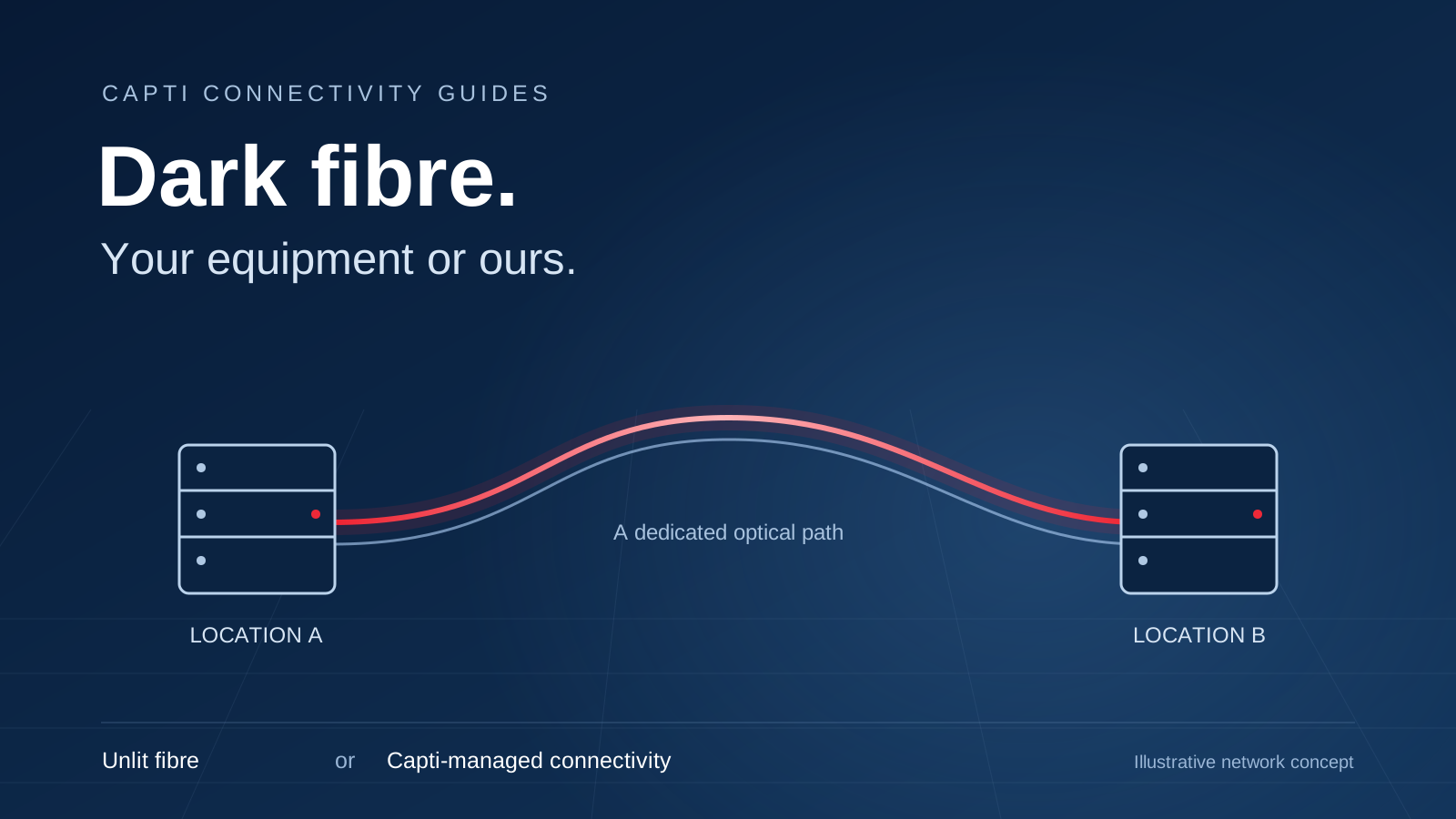
This is especially important when comparing a standard broadband service with a purpose-designed business connection. At Capti, business fibre, dark fibre, Reach Fibre through third-party carriers, fixed wireless, wavelength, cloud connectivity and private networks serve different requirements.1 Those are different solution types, not interchangeable labels, and all remain subject to availability and design.
2. Are the quoted speeds symmetrical, and are they guaranteed?
A headline such as “500 Mbps” may refer only to download speed. Upload capacity matters for cloud backups, large design files, off-site replication, video production, hosted applications and busy video-conferencing environments.
Ask for:
- download and upload speeds;
- whether each is a maximum, expected typical performance or committed rate;
- any shaping or fair-use conditions;
- how performance is measured; and
- what remedy applies if a commitment is missed.
Do not treat “up to”, “best effort” and “committed” as synonyms. They describe different risk positions.
3. What does the SLA actually cover?
“Business-grade” does not automatically define a service-level agreement. Request the SLA and read the measurement rules, exclusions and remedy—not just the summary slide.
Check whether it covers availability, fault response, restoration, latency, packet loss or jitter. Ask when the clock starts, whether it runs 24/7 or only during business hours, and what pauses it. Planned maintenance, power failures, customer equipment and third-party carrier faults may be treated differently.
Service credits are also not the same as compensation for business loss. An SLA can create accountability, but it cannot make an outage harmless.
4. Is the proposed redundancy genuinely independent?
A “backup” service is useful only if it avoids the failure that takes down the primary path. Two links can have different logos and still share a building entry, pit, conduit, upstream carrier, exchange, power source or network device.
Ask the provider to describe diversity at each layer:
- last-mile technology;
- physical route and building entry;
- carrier or network;
- termination equipment;
- power; and
- automatic failover method.
Complete physical diversity is not always practical or affordable. The point is to understand the remaining common failure points and choose consciously.
5. What is included in installation—and what could cost extra?
The monthly fee is only part of the commercial picture. Ask for installation charges, construction assumptions and potential variation costs.
Clarify who handles landlord or body-corporate approval, site induction, asbestos registers, riser access, internal cabling, civil works, rack space and electrical work. Confirm where the network termination device will be installed and whether cabling from that point to your communications rack is included.
Request a documented process for approving additional costs. “Subject to site survey” is normal; an uncapped surprise is not.
6. When does billing and the contract term begin?
Businesses often plan a move or opening around a target date, but telecommunications delivery can involve third parties, access permissions and construction.
Ask for the estimated delivery stages, dependencies and communication cadence. Then clarify:
- whether billing starts at order, installation, activation or acceptance;
- whether the contract term starts on the same date;
- what acceptance testing occurs;
- what happens if delivery is delayed; and
- whether you can cancel if the final design or cost changes materially.
Keep your existing service running until the replacement has been installed, tested and proven wherever possible.
7. Who supports me at 2 am, and what can they see?
A support phone number does not reveal the operating model behind it. Ask about support hours, escalation paths and which team handles an active outage after hours.
Find out whether the provider monitors the service proactively or waits for you to report a problem. Ask what telemetry support staff can access, whether they can test the network termination and managed router, and how updates are delivered during an incident.
If your business trades nights or weekends, a weekday-only escalation path may not match your risk—even if the connection itself operates 24/7.
8. What equipment, addressing and security are included?
Confirm whether the router is supplied, rented, managed or owned by you. Ask who controls its configuration, who applies firmware and security updates, and what happens to the device at contract end.
Document technical requirements before ordering: static public IP addresses, IPv4 or IPv6, bridge mode, routing protocols, VPN compatibility, voice support, guest networks and any cloud or data-centre interconnection.
Security add-ons deserve the same precision. Ask what a DDoS, firewall or filtering service protects, how it is activated, what reporting is provided and what remains your responsibility.
9. What are the full-term costs and exit conditions?
Build a simple whole-of-contract comparison. Include installation, monthly access, equipment, managed services, usage charges, support options, annual increases and expected move or cancellation costs.
Read the early termination formula. Ask what happens if you relocate, sell the business, change tenancy or need more capacity. Can the service be upgraded without restarting the full term? Is renewal automatic? How much notice prevents rollover?
A longer term may support lower pricing or construction recovery. That can be reasonable, provided the trade-off is visible.
10. Which assumptions should appear in the order form?
Your final question is the most powerful: “Can you put that in the contract or service schedule?”
Record the promised access type, speeds, installation boundary, target location, equipment, IP addressing, support level, SLA, diversity assumptions, fees and contract dates. Attach the final design and quote. If an answer matters to your purchasing decision, it should not live only in a sales call.
A quick comparison scorecard
Before approval, score each proposal against the same headings:
- fit for current and forecast usage;
- upload and download performance;
- service commitments;
- resilience and common failure points;
- delivery confidence;
- support model;
- security and technical compatibility;
- whole-of-term cost; and
- contract flexibility.
Weight the categories according to business impact. A small office using cloud email may choose differently from a medical practice, warehouse, call centre or multi-site operator. There is no universally “best” connection—only a better fit for a defined requirement.
We can discuss fibre, fixed wireless, cloud and private-network options, including the support and service boundaries required for your business.1 The right starting point is still your requirement, location and risk profile rather than a product name.
Comparing proposals or planning a new site? Talk to Capti with your address, user count, critical applications, preferred installation date and outage tolerance. We’ll help you ask the practical questions and explore an appropriate design, subject to availability and agreed terms.
For more detail, read about dark fibre versus managed business fibre. Explore business fibre options for your location.